Hollywood currently lives out an obsession with recycling its own past. Reviving old franchises became the main survival rule for major studios. Modern audiences consume remakes, reboots, and sequels in a seemingly endless cycle.
In this landscape marked by exhausting repetition, filmmaker Jane Schoenburn delivers a creative breather. Her new work completely dodges the easy traps of commercial nostalgia. Reading this Miasma Camp review will show how the film uses horror tropes to build a smart satire.
The American director already demonstrated her talent for dissecting media in the highly praised I Saw the TV Glow. In that feature, consuming a television show served as the narrative thread. Now, her authorial lens aims directly at the film industry and pop culture.
The result is a work that distorts our fondest memories. The production proposes an acid reflection on the behind-the-scenes of modern entertainment. All of this comes wrapped in a massive allegory about desire, repression, and the female orgasm.
The Requel Fever in Miasma Camp
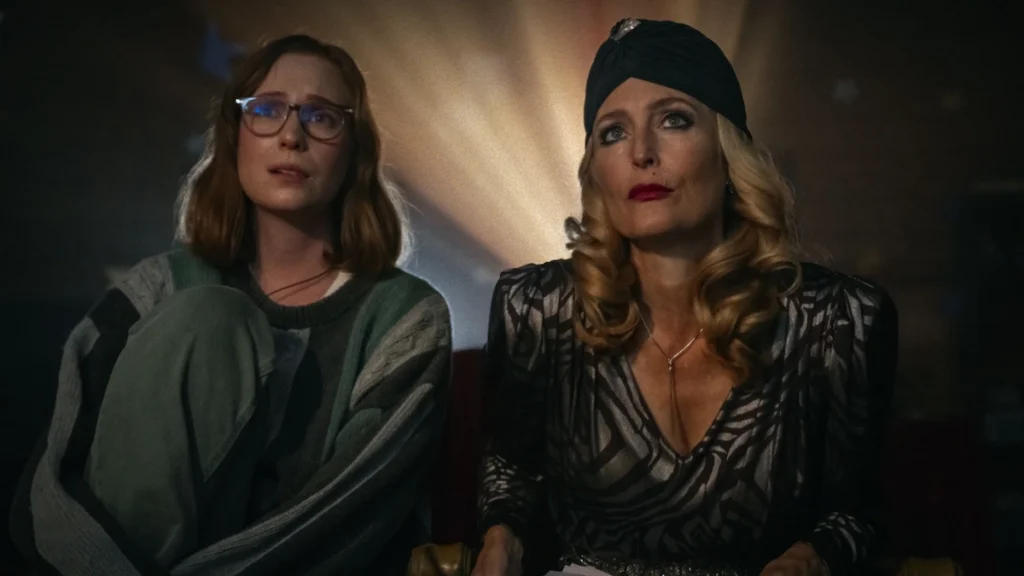
The main plot follows the steps of Kris, played by comedian Hannah Einbinder. The character is a young director who just broke out at the prestigious Sundance Film Festival. Just like in real life, the industry quickly recruits her to helm a massive project.
The newcomer’s challenge is to take over the reboot of the battered 1980s franchise Miasma. The mission goes way beyond directing a script full of fake blood. Kris needs to convince the absolute star of the original film to return for this new version.
This is exactly where the talented Gillian Anderson steps in as Billy Presley. The actress lives a harsh and highly common reality for the so-called “Final Girls” of the past. Unlike the icon Jamie Lee Curtis, Billy failed to consolidate a successful mainstream career.
Her refusal to participate in the original sequels cost her a spot under the Hollywood spotlight. The meeting between the rookie filmmaker and the forgotten veteran dictates the rhythm of the plot. Schoenburn uses this dynamic to criticize the industry’s pathological need to profit from old intellectual properties.
The Shadow of Jason Voorhees and 1980s Horror
The director deeply understands the roots and rules of slasher horror. Films like Psycho, The Texas Chain Saw Massacre, and Friday the 13th shaped a very rigid playbook. The work plays with this bloody tradition right from the opening credits montage.
The opening perfectly summarizes the declining trajectory of any major horror saga. We see the lightning-fast rise, the wear and tear caused by bad sequels, and the totally unnecessary remakes. These elements build the rich mythology around the fictional Miasma franchise.
The giant shadow of Jason Voorhees clearly hangs over the entire aesthetic of the production. The current psychopath hides his face using a bizarre mask made from a piece of ductwork. The killer’s visual image carries the heavy irony that defined the productions of that era.
The technical resources also openly pay homage to the subgenre’s classics. The first-person camera simulates the predatory vision of the maniac hunting his prey. The heavy breathing behind the mask and the rhythmic soundtrack make a constant appearance.
Meta-Fiction Far From Amateurism
Many directors use a parodic tone in a shallow way or rely on cheap humor. Others explore meta-fiction by directly copying the formula established by the Scream franchise. Schoenburn prefers to walk a much safer, authorial, and self-assured path.
The filming style transmits the confidence of someone who knows exactly what they want to question on screen. The feature avoids mere fan service and rejects cheap nostalgia. The visual references are not there just for the audience to point at the screen.
The director recreates iconic camp horror moments through an almost dreamlike perspective. The famous and repetitive scene of the impaled couple gets a completely fresh look. The blood and violence take on the contours of a feverish and uncomfortable delirium.
The cinematography helps compose this nightmare atmosphere recorded in an amateur way. A filter that simulates a highly deteriorated VHS tape covers a large part of the forest sequences. This aesthetic resource transports the viewer straight to the shelves of old neighborhood video rental stores.
A Queer Lens to Survive the Slasher
Slasher cinema carries a rather complicated history in its narrative foundations. The 1980s works usually abuse openly misogynistic conventions and transphobic remarks. The traditional rule that sexually active teenagers die first reinforces a puritanical conservatism.
The non-binary filmmaker decides to rewrite these moral rules using a purely queer lens. The subgenre gains fresh and authentic contours in the director’s hands. The script replaces structural sexism with high doses of visual surrealism and liberation.
The dynamic between Einbinder’s and Anderson’s characters changes the temperature of the work. The classic relationship between a fervent fan and a decadent idol quickly crosses professional boundaries. The conversations awaken a strong sensual fantasy between the two women at the center of the narrative.
Schoenburn mixes the graphic violence of horror with a highly magnetic level of eroticism. The line separating Kris’s reality from the camp’s fiction begins to fade. The result is a playful tone that invites the audience to reflect on their own repressed fears and desires.
Desire, Orgasm, and the Little Death Metaphor
The script builds a powerful allegory about the discovery of the female orgasm. The bizarre masked killer receives the suggestive nickname of Little Death. The French expression has served for centuries as a famous slang to describe the sexual climax.
This clever concept transforms the usual forest chases into something much bigger. The terror of running away from the threatening figure gains heavy layers of psychological repression. Survival ceases to be physical and begins to represent an urgent search for intimate freedom.
The famous miasma present in the cursed lake receives a totally new emotional meaning under this narrative perspective. The setting stops being just a killing ground to become an experimental space. The rules of the traditional slasher never managed to explore themes with such acidity and courage.
The masks that immortalized horror icons also undergo a brilliant resignification. They begin to represent the social barriers that characters use to hide their true essence. The journey of tearing off these protections dictates the dramatic arc of the two protagonists.
Sharp Performances and the Final Verdict
The production hits its peak brilliance in the execution of interpersonal tension. The meta-fiction of the “film recorded inside the film” works as a very well-adjusted narrative mechanism. The story delivers direct criticisms to the audiovisual market without losing focus on the protagonists.
The only real stumbling block in the editing lies in the prolonged execution of its third act. The climax feels too long and ends up unnecessarily testing the viewer’s patience. The final sensation is that of a closing that hesitates when it is time to roll the credits.
Even with this slight excess in runtime, the dramatic payoff is worth the effort. The absurd chemistry between Gillian Anderson and Hannah Einbinder carries the movie effortlessly. Both actresses deliver complex, sharp performances and possess enviable comedic timing.
Miasma Camp is a brave study on obsession, trauma, and media consumption. The narrative transitions perfectly from good-humored satire to peaks of total visual discomfort. Jane Schoenburn proves, with great class, that slasher horror still holds room for bold reinventions.